Thursday, July 24, 2008

Camp sights: Part Three


On the beach...


The Bay of Pampelonne is 5 kilometres of sand divided up into public and private beaches. It was also one of the sites for the Provence Landing of 1944 and was soon to be the site for the lesser-known Baconnier landing of 2008.

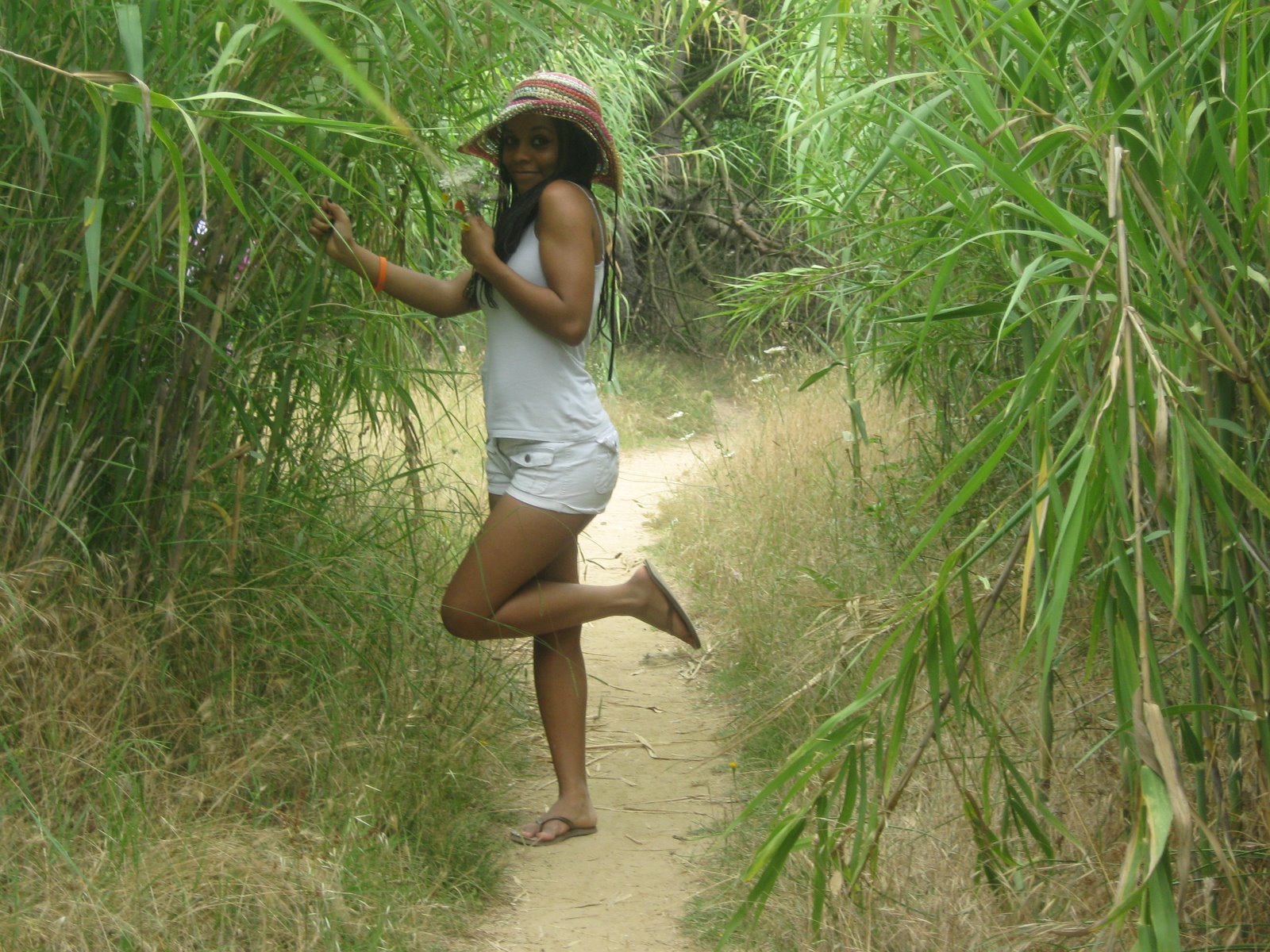
They told us at the campsite that the beach was just down the dirt track that wound through vineyards and bamboo plantations. It sounded terribly exotic so we set off, me in my glamorous new silver flip-flops and the girls in their micro-shorts and tiny strappy tops.

It was further than we imagined and at one point we had to cross a busy main road. We stood hesitantly on the verge while young men in sleek sports cars sped past, flashing their lights and sounding their horns as my girls giggled prettily. Well, they are gorgeous. I was quite flattered when someone beeped their horn at me - until I realized it was because I was in the middle of the road and in danger of being run over…

When we finally stumbled onto the mythical beach, my feet were bleeding profusely and I had to take off my flip-flops. Walking barefoot on the sand was like walking on shredded Brillo pads but it was either that or lose one of my toes. By this time, the girls had decided I was cramping their style and had gone on ahead. But why were they staring at the ground? Had they suddenly lost confidence in the face of all this glamour?


Then I realized. This was a nudist beach. My girls are not used to seeing so much flesh and so many dangly bits on show, especially when the flesh was a little – how shall I put it? – past its prime. Still, it made me feel better about my own floppy bits.

In fact, a few days later, I came to this beach on my own for a bit of topless sunbathing. At least no-one would bat an eyelid at a pasty plump English woman baring her boobs. Now, my boobs are a little on the large side – let’s say that anyone sitting next to me wouldn’t need a parasol – but surely they wouldn’t draw attention here, would they?

Wrong. After a few minutes of blissful sunbathing, a shadow fell across my body. Then I heard a series of hoarse grunts and a man’s voice murmuring “Oh là là. Oh là là. Oh LA LA!” I immediately hitched up my bathing costume and rolled over. The Pervert of Pampelonne grinned lasciviously and walked away while I opened my book and vowed never ever to go topless again.

Still, I’ve got nice tanned ankles now. Pity I can’t wear the flip-flops…

Wednesday, July 16, 2008

Camp sights: Part Two


The English Abroad.


A play in one act.


St Tropez: a mediaeval port that has lost none of its charm; its narrow streets wind lazily beneath the sun as azure waves lap softly against the ancient shore.

Gigi is strolling along the seafront when a lion-like roar (in a broad northern English accent) rips through the air. A large, purple-faced man is gesticulating menacingly in the middle of the street:

Angry tourist: Police! Get me the police! Anyone 'ere know where the police station is? Shut up you. I want the police NOW!

Gigi: Ahem - can I help perhaps?

Angry Tourist: Yeah, I ordered mools mariner, right? And when it come it were too salty an' there were no wine, no cream, nothing so I said…

AT’s Wife: We've only bin 'ere two days.

AT: So I said I’m not 'aving this rubbish take it away. I’ll 'ave what 'e's 'aving cos the bloke next to me were eating a pizza.

AT’s wife: Disgusting it is.

A French waiter, who has been standing calmly by and is now on the phone to the police, smiles tightly at Gigi.

Waiter: Ils sont partis sans payer.

AT: An' the waitress brought the pizza, right, and she slapped it on table an' said "There is no wine with this meal."

Waiter: Et il l’a traitée de pute.

AT’s wife: This is disgusting, this is. We've only bin 'ere two days.

Gigi: Er – the waiter said you left without paying and you insulted the waitress…

AT: No I never, stupid cow. POLICE! Where's the police? I want the police.

Waiter: No problem, monsieur– you are going to spend ze whole day wiz ze police. Zey are on their way.

AT: I want the British Embassy! Someone phone the British Embassy!

AT’s wife: My 'usband's not well. 'E's already 'ad one heart attack. It's disgusting, it is. We've only bin 'ere two days.

The Angry Tourist clutches his chest and starts moaning loudly.

AT: Oooh! Arrgghh! Get an ambulance, quick! Oooh…

Waiter: No problem, monsieur – what is ze number for ze eenglish ambulance?

AT: Nine – nine - nine.

Gigi: Well, er – I’d better be off. Um – I’m sure the police will sort it all out.
(To the waiter) Je suis désolée. Nous ne sommes pas tous comme ça. Bon courage…


FIN

Monday, July 14, 2008

Camp sights: Part One


I have just come back from ten wonderful days in Ramatuelle with two of my children. We did hardly anything at all except sleep, read and sunbathe and it was perfect – well, almost.

I’ve never been camping with my children before. If we ever went on holiday, it was with my husband and he did all the booking, organising and driving. I am quite proud, therefore, that I managed to do all these things by myself and only got lost a teeny weeny bit at the end – hardly anything at all really; I just missed the turning for the campsite on the route des plages and had to do a nifty U-turn in a vineyard. No problem.

We stayed in a bungalow toilé. This was not some grotesque parody of English suburbia as I had first imagined, but a glorified furnished tent full of zips: the cupboards were zipped, the bedrooms were zipped, the windows were zipped, the door was zipped…Forget the sweet, soft chirping of crickets at dusk - every evening at bedtime, the air fairly resonated with the sound of zips.

The showers were great, which was a good job, since my two girls had refused to leave home without at least three kilos of make-up and toiletries – each. The loos, on the other hand, were Turkish. These holes in the ground have always inspired in me fear and loathing: what if I slip and get my foot stuck? What if I overbalance? It has not happened so far although the last one I frequented had a rather aggressive automatic flushing system which took me by surprise because I hadn’t quite finished…

There were a lot of Dutch and German people at the campsite, all tall with headfuls of gleaming Boris-Johnson hair. Our immediate neighbours - a blonde couple with two blonde, well-behaved children - provided us with fine examples of Teutonic discipline. When we staggered out of our bungalow at midday, bleary eyed and dishevelled, they had already left (at dawn) to visit some interesting, historical monument. They had prepared a healthy picnic and never forgot their sun block. I know this because I once got up very early to go to the loo and saw these items neatly aligned on their table. Our own table was strewn with the debris of the previous evening’s meal (cheese rind, gobs of pickle, apple cores and crisps) and our beach towels were hanging off the backs of the chairs rather than neatly pegged on the clothes horse provided. They also aligned their shoes on the terrace and I never once heard them yell ‘Where the *µ@% is my other flip-flop?’ as we did quite often.

It was a ‘family campsite’ which is a euphemism for ‘very noisy’. On most evenings, an animation was provided. We never went to any of these – we didn’t need to because we could hear everything from the comfort of our own beds. On the first night, an extremely irritating ventriloquist with a stupid voice kept us awake until half past eleven (I would have told him just where he could throw his voice but I am far too polite). The following evening, we were regaled with a couple of slightly out-of-tune guitarists who were obviously having a bit of plectrum trouble and a few nights later, a magician - who sounded suspiciously like the ventriloquist – performed an act which seemed to consist in shouting ‘Are you having fun, children?’ every five minutes to a worryingly silent audience.

Of course, it wasn’t really proper camping but it was bucolic enough for my tastes. I bravely squashed a huge spider with my shoe but I am ashamed to admit that when a giant cricket found its way into my children’s bedroom one night, I was unable to come to the rescue. Once more, it was my fearless daughter, Rachel, who found the courage to dispose of it (after suffocating it with fly spray) while I trembled in my own safely-zipped-up room like the despicable coward I am.

To be continued…


Saturday, June 21, 2008

Liberty, Equality and Strikes


The other morning, I thought I heard rioters outside my door. Hundreds – perhaps thousands – of people were hurling incomprehensibly; traffic had come to a standstill; I could smell tear gas. Nevertheless, I ventured outside. Call me foolhardy if you wish, but I needed to buy some bread for lunch…

A substantial portion of the unruly mob was shabbily dressed. Men with straggling grey hair and corduroy trousers were brandishing placards; ferocious-looking women were punching the air with menace. The strains of a seventies’ protest song struggled to keep afloat above the chanting crowd while police stood on street corners looking a trifle bored. I spotted my daughter’s history teacher and nodded pleasantly. Ho hum. The teachers were on strike. Again.


The origins of the phrase faire grève, which means ‘to go on strike’, have more to do with looking for work than stopping it. The word grève means ‘gravel’ and by extension ‘shore’. In Paris, in the fourteenth century, workers would wait on the ‘shore’ of the Seine hoping for employment when the ships came in. The area was known as Place de Grève and functioned as a sort of job centre without the paperwork. It wasn’t until the end of the nineteenth century that the phrase acquired its present meaning, when it finally became legal to go on strike.


Oh, they like a bit of Revolution, do the French. Look at Robespierre. He would have been right up front today with a megaphone and a handful of flyers, egging everybody on. Indeed, these strikes are a sort of Reign of Terror, although the rolling of heads is just a figure of speech and the only chops to be had are lamb ones sizzling on the barbecue set up in front of the Préfecture (this is France, remember, and not even strikers would forgo their lunch). And who could forget mai ’68, when a student protest meeting in Paris sparked off a month of violent riots involving not only students but workers, school children, teachers and university lecturers? In a spectacular example of overreaction, the CRS – French riot police – were immediately sent in with truncheons and tear gas. The demonstrators reacted by building barricades, setting cars alight and hurling paving slabs. Hundreds of people were wounded on la nuit des barricades (the Night of the Barricades), including seventy-two policemen, but this merely added fuel to the fire. The trade unions joined the movement and by the end of les évènements, over ten million strikers had brought the whole country to a standstill. De Gaulle had even contemplated bringing in the army…


Yet, despite the violence and the inevitable shake-up of French society, the demonstrators aroused much public sympathy and this is still the case whenever there is a strike. In 1997, the lorry drivers went on strike and blocked access to the refineries so nobody could get any petrol. Did anyone complain? No. Even my (sort of ex) husband, whose fuse is so short he makes Basil Fawlty look like a monk on Prozac, happily stacked jerry cans full of petrol in the garage without so much as a murmur. And what about the civil servants? Normally the target of vicious and paranoid mutterings from the seventy-five per cent of the French population who do not work for the state, they suddenly become paradigms of virtue whenever they go on strike. Or maybe it’s just not that easy to tell the difference… Striking while the iron is hot, so to speak, the unions make sure they cause a maximum of inconvenience to everybody - which is, of course, the point. We all know that every year, the postmen will go on strike in the run up to Christmas and the dustbin men will choose the hottest month of summer.


Ask any French person if they think all this is thoughtless, foolish or downright mean and they’ll reply cheerfully that no – it’s democracy. Strange, then, that a mere ten per cent of the French working population belong to a trade union, compared to twenty per cent in the United Kingdom and a whopping eighty per cent in Sweden. Another French paradox, evidently…


Back to this morning, and as I waded through the throng in an attempt to reach the boulangerie on the other side of the road, I thought fondly of my seventeen year old daughter. She has also been on demonstrations for the past four Thursday afternoons with the rest of the lycéens, protesting against a proposed educational reform. How mature she is for her age, I mused – she has already found a cause to fight for! Was I witnessing a political activist in the making? A future leader of the Green Party, perhaps?

“So, dear,” I asked her at lunchtime. “Why exactly are you doing this?”

My daughter shrugged.

“Well,” she said. “There’s a chance I might be on telly…and also I get to miss maths.”

Maybe I shouldn’t have asked.

Sunday, May 11, 2008

Purple Haze


As a child, I hated the smell of lavender. It reminded me of elderly ladies, furniture polish and that can of air freshener we always had in the bathroom. Now, however, it is one of my favourite scents which leads me to think that it is perhaps a smell one acquires as one gets older and more sophisticated, rather like acquiring a taste for olives or oysters or wine. Either that or I’ve been overdoing the aerosol sniffing again…

Lavender is a wild, aromatic shrub that loves the sun and thrives in dry rocky soil. It originated in Persia and the Canary Islands and has been in documented use for over two thousand years. The Egyptians used it as scent and as an ingredient in the mummification process; the tribes of Gaul used a lotion made from lavender essential oil called celtic nard and it is possible that the nard mentioned in the bible – the ointment with which Mary anointed the feet of Jesus – was also lavender. The plant was brought to Provence by the Romans who used it to scent their linen or their bathwater – hence the name ‘lavender’ from the Latin lavare – which means ‘to wash’.

Three types grow predominantly in the south of France. Lavandula vera or true lavender, which grows above 800 metres; lavandula augustifolia also known as ‘asp’ lavender because it is a favourite hiding-place for snakes and lavandula hybrida, a hybrid of the above which can grow at a much lower altitude and has a higher yield of essential oil. English lavender, brought over by monks when they fled the French Revolution, is lavandula augustifolia.


Lavender was (and is) used for its medicinal properties: Pliny the Elder mentioned it in his writings and Dioscoride, a Greek doctor and botanist who lived in the first century, advocated lavender tea as a cure for headaches and insomnia. In the twelfth century, the abbess and herbalist, Saint Hildegarde de Bingen, recommended lavender eye drops and believed that lavender promoted ‘pure knowledge and reasoning’ – whatever that means. In the fourteenth century, people carried around bunches of lavender as protection from the plague – and indeed, it may have helped as lavender does repulse fleas. In the sixteenth century, it was used as a treatment for mental disorders and chewing on it was believed to restore speech to those who had lost their voice – the sufferer’s first words presumably being ‘Yuk – what is this stuff?’. Later, it was discovered to relieve rheumatism, catarrh, vertigo and period pains, mood swings, digestive headaches – an intriguing condition that translates as flatulence on the brain – hysteria, asthma and ringworm…to name but a few. Lavender was indeed a panacea.

It had other uses, too. Rubens and his fellow painters used lavender oil as paint thinner and it is thought that this is why the colours have retained their brilliance over the centuries. It also had its place in superstition– lavender kept away the evil eye; rubbing the flowers on one’s forehead before going to sleep ensured premonitory dreams; a few drops of lavender in one’s toilet water prevented marital discord (hmmm – wish I’d known that before). In Provence it is said that a man who eats lavender flowers while standing in a vineyard that has been abandoned for more than twenty years has a sporting chance of seeing ghosts…and frankly, if he’s going to go to all that trouble, he deserves to see ghosts…


As if that wasn’t wacky enough, as recently as 1965 a 41- year old lavender farmer, Monsieur Maurice Masse, spotted a rugby ball-shaped object in the middle of his field on the Valensole Plateau. Moving closer, he noticed two small beings busy gathering lavender. Now Maurice, being quick-witted and not at all one stalk short of a posy, realised at once that he was in the presence of aliens (rather than two small boys who had just come to get their ball back.) What were they doing? Taking samples, perhaps? Was lavender an essential component of a new deadly weapon with which they would take over the earth? Were they going to genetically modify it? Or did they simply have a problem of lavatory odour on board? Maurice would never find out. The aliens saw him and zapped him so that he was paralysed and could only watch helplessly as they boarded their vessel and shot off into space. The mystery was never elucidated but for many years afterwards, no lavender or plant of any kind grew in the spot where they had landed…and Maurice is now in the Twilight Zone…


Lavender is a herb, like rosemary or thyme and is an ingredient of herbes de Provence. Chicken and lamb are particularly good with lavender and lavender cream, lavender ice-cream and lavender mousse are delicious. If you put a few sprigs of lavender with sugar in an airtight jar you can make wonderful lavender-flavoured cakes and biscuits. However, it is a pungent herb and must be used sparingly if you don’t want your food tasting of fabric softener. Lavender honey, on the other hand, has a delicate, fragrant, summery taste. Pale and golden, it is considered by many to be the best tasting honey in the world as well as having healing properties…talking of which, I feel a bit of brain flatulence coming on and I’m going to need to take my medicine…and what better way to take it than dripping off warm toast?


Wednesday, April 09, 2008

Waterway to go...


France has a rich network of canals. If you wanted to – and if you had the time - you could travel from north to south and from east to west without ever setting foot on dry land. There are quicker ways to do it, of course, but why rush?


Canals have been around for thousands of years and France has a great tradition in hydraulic engineering that reaches back to the twelfth century. They were built initially for irrigation and then as a means of linking towns to rivers but it wasn’t until the sixteenth century that the French began to build longer canals – a feat made possible by the invention of locks. In 1526, a man with the unfortunate name of Adam de Craponne, was born into a noble family in Salon-de-Provence. A hydraulic engineer, he developed several canal networks in the region but his most famous canal, the Canal de Craponne, provided water for Salon and irrigation for the Crau, an arid rocky plateau nearby. At sixty-two kilometres, it was the first grand canal. Monsieur de Craponne not only invested his entire fortune in the project, he also had to borrow money from his friend, a certain Nostradamus - who evidently foresaw a great future for canals. Unfortunately, he was unable to foresee Adam de Craponne’s fate: he died a ruined man, poisoned - so the story goes –by rivals.


Probably the best known canal in France is the Canal du Midi which was built to link the Atlantic Coast to the Mediterranean. The idea had existed for over a thousand years - the Roman emperors Nero and Augustus considered it as did Charlemagne, Francois I, Charles IX and Henri IV. Several attempts were made at building a canal but they all failed.


The reasons for building one were simple: the sea route around the coast of Spain was not only long (3000 kilometres) – it was also dangerous because of pirates. Moreover, the Straits of Gibraltar were controlled by the powerful Spanish Kingdom who lined its coffers at every passage. This would be a way to weaken Spain’s economy.


In the seventeenth century, in the reign of Louis XIV, one man made the building of this canal his life’s work. His name was Pierre-Paul Riquet, a tax collector from Béziers. Within twenty years he had become very rich (no questions asked) and launched himself into the project with dedication and almost foolhardy enthusiasm. In 1666, the King issued an edict for the construction of the canal and work was begun the following year.


The canal was built to link the Garonne river at Toulouse (which flows into the Atlantic at Bordeaux) and the Etang de Thau, one of a string of lagoons along the Languedoc coast. It was a great challenge that had defeated many an engineer before him, not least because of the features of the landscape. But Riquet was undeterred. When he came to a hill, instead of going around it, he built the world’s first canal tunnel – le tunnel de Malpas; when the ground sloped, he built a lock and when a river had to be crossed he built an aqueduct. Today, there are three hundred and twenty-eight such constructions – some of which are over three hundred years old.
Twelve thousand people worked for him. He paid them above the going rate and – unheard of at the time – he paid them on their days off (which included rainy days) and when they were ill. They were even provided with subsidised housing. Needless to say, this didn’t make Riquet terribly popular with other, less generous employers…


Poor Riquet died exhausted and bankrupt in 1680, just a few months before the canal was completed. His son carried on the work and in 1681, it was inaugurated by the King. Known as the Canal Royal de Languedoc up until the French Revolution, it was renamed the Canal du Midi by paranoid revolutionaries.


From the very beginning, the canal was used to transport people and mail as well as merchandise. The Barque de la Poste (Postal Barge) took four days to travel the 240 kilometres from Toulouse to Agde and stopped regularly along the way to allow its passengers to eat (the stops were called dinées) and to sleep (couchées). At every stopping place there was a chapel, an inn and stables for the horses that pulled the barges. Horses were used for traction until the 1930s, when motorised barges replaced them.


Between 1830 and 1856, another canal was built linking the Canal du Midi to Bordeaux because the river Garonne flowed too slowly to be economical. Ironically, the Bordeaux-Sète railway line was finished at around the same time and marked the beginning of the decline of fluvial transport.


photo www.canal-du-midi.org


Today, the canals are known collectively as Le Canal des Deux Mers: - Canal of the Two Seas – which covers a total distance of over four hundred kilometres. In 1996, it was declared a World Heritage site by UNESCO. Together with the other 6300 kilometres of waterways in France, it accommodates thousands of tourists messing about in boats every year while cyclists and walkers travel the old towpaths beneath the shade of the plane trees. It is a wonderful way to experience the variety of France and a perfect opportunity to just relax - and go with the flow…

Friday, February 22, 2008

French bloomers


There are two flower festivals in France during the month of February: la fête de la violette in Toulouse and la fête du Mimosa in the south of France. It’s nice to have something to brighten up the dull wintry days between Christmas and the first signs of spring.

I remember eating Parma Violets when I was a child and calling them ‘perfume sweets’ because I thought that’s what they were made from. In a way, I suppose, they are. Perhaps Toulouse, called la ville rose because of the colour of the buildings, should have been named la ville violette after the flower that is its emblem. Certainly, the Parma violet is omnipresent in this town. As you stroll beside the Canal du Midi, a heady scent drifts along the towpath from La maison de la Violette - a fragrant barge that has been turned into a shrine to this purple flower with its heart-shaped petals. Once inside you are offered a crystallised violet (only one, I’m afraid) and are free to look around and learn about the history and the uses of this flower.


In ancient Greece, the violet was considered a symbol of fertility and love and it was used in love potions. As it was also used as a cure for a headache, the recipient had no excuse not to succumb. Violets were used extensively in the middle-ages both in cookery and in medicine: apothecaries made cough syrup from them and they were used to add colour and flavour to food.

During the sixteenth and the seventeenth centuries, they were still used in cookery but it was also fashionable in court to douse oneself liberally with violet-scented powder to mask bodily odour - although violet-scented soap may have been a better idea…

Violets were Napoleon’s favourite flowers. Josephine wore them on her wedding day and Napoleon sent her a posy of violets on every anniversary. After her death, he picked violets growing on her tomb and wore them in a locket around his neck. In exile on the Isle of Elba, he promised his followers he would return in the spring… with the violets. This earned him the nickname of Caporal Violette and the flower became his emblem, worn by his followers in his honour. Suddenly violets were everywhere: on pots, on clothes and on postcards. The postcards looked innocent enough but they were cleverly drawn and on closer inspection, revealed the outline of Napoleon’s portrait cunningly camouflaged. When he returned from exile, women offered him bouquets in the street and violets were strewn beneath his feet. Up until 1874, the French government tried to ban – with little success - any reproduction of a violet because it was the symbol of the Bonapartists


In the language of flowers, the violet is symbolic of faithfulness in love. It is associated with Valentine's Day too, since legend tells us that violets grew outside the window of the jail where Saint Valentine was imprisoned. And in a profound philosophical statement, this delicate, sweet flower also represents death...


Mimosa, on the other hand, represents sensitivity and feminine energy – whatever that is (I certainly haven’t got any…). This sunshine-laden tree is a member of the acacia family and was brought to the Mediterranean from Australia in the early nineteenth century. Rich Europeans planted it in the gardens of their villas on the French Riviera and enjoyed the masses of golden flowers that bloomed in the late winter months. Mimosa is prized for its delicate fragrance and is a component of several well-know perfumes as well as being used to scent soap and other products of the perfume industry.


Mimosa growers are called mimosistes and between January and March, they export more than eight million bouquets of their flowers all over the world. The fête du Mimosa takes place mid-February in the small town of Mandelieu-la-Napoule where the streets are vibrant with music and gaily-coloured floats. La mimosette – a cream-filled brioche decorated with mimosa and made from a secret recipe - is baked especially for the occasion and you can also buy mimosa syrup, sweets and even jelly.

photo mandelieu


In aromatherapy, mimosa is taken to relieve anxiety and depression and to liberate oneself from “oppressive memories”. It apparently provokes feelings of joy and lightness of spirit and the truly whimsical can use it to induce prophetic dreams.


On a less picturesque note, mimosa extract is used to treat a variety of ailments including swollen ankles and sensitive skin. The bark is used to make an astringent gargle and to treat colic and… chronic diarrhoea.


I expect that is where the feelings of joy and lightness come in…