Friday, October 26, 2007

Grave circumstances


November is a bit of a morbid month here with three days, including Armistice Day, devoted to remembering the dead. The first, All Saints’ Day – or Toussaint - is a public holiday and, although it sounds nice and holy, it has its roots in pagan mythology. Like Hallowe’en, All Saints’ Day was created to supplant the Celtic celebration of samonios (samhain) which marked the end of summer. In the eighth century, Christian monks who had come as missionaries to Gaul found themselves witness to strange rituals and dark goings on at around the beginning of November. People would lay places at the table for deceased relatives and light candles and lanterns to guide the dead souls whom they believed mingled with the living during this time. These practices were so deeply anchored in the rural population that they endured in one form or another even after conversion to Christianity. In fact, in certain parts of France today, people still light lanterns for the dead and in Brittany, they pour milk on the tombs as an offering. I bet it curdles...

In the ninth century, Louis the Pious instituted a feast day for all the saints with the aim of replacing the pagan feast of the dead with a joyous Christian celebration. As usual, the French didn’t take a blind bit of notice and carried on inviting their ancestors to dinner. To cater for this, the Roman Catholic church had to invent a ‘Feast of the Dead’ on the second of November but to this day, most French people choose to remember their ‘disappeared ones’ on the first – probably because it is a holiday.


The day begins for many with mass followed by a family lunch - to which only living relatives are invited - and in the afternoon, everyone goes to the cemetery to put flowers on relatives’ tombs and tidy them up a bit. The traditional flowers are chrysanthemums because – like everything else in the cemetery – they need very little looking after and do not mind the cold. It is the ultimate faux-pas, of course, to offer chrysanthemums to anyone on any other occasion, unless you are trying to drop some sort of grotesque hint.

Cemeteries in France are beautifully kept and many are listed as historical monuments. The idea of cutting through one en route to the shops or nipping in for a sneaky fag on your way home from school would be shocking and incomprehensible to the French. It is important to keep grave plots neat and tidy and woe betide the slatterns who let their epitaphs get dusty – they’ll get a stern dressing down from the town council and more than a few cold stares. Like prisons, cemeteries are surrounded by high walls, the gates are locked at night and there are strict rules to be obeyed: singing or playing music is prohibited except for liturgical chants and military music; you are not allowed to enter if you are drunk or under fourteen and unaccompanied; animals are forbidden except for guide dogs and you are not allowed to take photographs without permission. A quarter of an hour before closing time a siren sounds, loud enough to wake the…well, never mind…and a uniformed keeper walks round to check in case anyone was thinking of spending the night there.


In the village of Mens, 55 kilometres south of Grenoble, you can find private Protestant cemeteries. They were established during the Reformation when Protestants were forbidden by Catholics to bury their dead in 'true Christian' ground. There is also a cemetery divided in two by a low wall: on one side are the Catholic graves - neat and tidy and decorated with photographs and flowers and dinky little statues; on the other side are the Protestant graves - plain, austere and overrun with vegetation...
The most famous French cemetery is Père Lachaise in Paris, established by Napoleon in 1804. This is the place to be buried for any...er... body who is anybody. Chopin is buried here as is the painter Pissarro; Jim Morrison’s grave is regularly besieged by fans and it is traditional for admirers to kiss Oscar Wilde’s tombstone while wearing lipstick. Today there are more than 300,000 people here ‘eating dandelions by the root’ (French for ‘pushing up the daisies’), making Père Lachaise the biggest cemetery in the city of Paris.


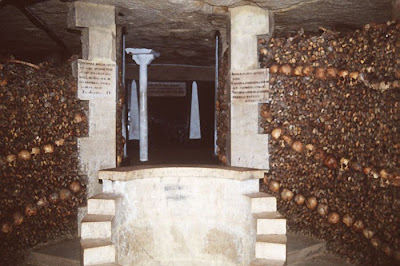
Perhaps the most unusual burial place in Paris is les catacombes. These are a network of tunnels and rooms beneath the city in what was once the site of Roman quarries. In 1786, bones from the cemeteries in the centre of the city were moved here as they were presenting a health hazard. There are about 186 miles of tunnels beneath Paris and only a small section is open to the public but of course, that doesn’t stop the cataphiles – catacomb lovers or urban explorers, as they prefer to call themselves - from using the many secret entrances to gain access and hold wild parties amongst the artfully arranged skulls and bones of about six million people. Well…they’re not disturbing anyone, are they?


Another unusual burial site lies beneath the deconsecrated church of Saint Laurent in Grenoble. More than 1,500 tombs have been uncovered that include fifth century mausoleums, seventh century sarcophagi and other tombs dating from the fourth century right through to the eighteenth. The church is now a museum, and you can walk around the crypt on gangways suspended above it and peer into the open stone coffins. Fortunately, they are empty now but I am nevertheless reminded of the words carved on one Frenchman’s headstone: Just leave me to sleep. That's why I'm here…

Saturday, October 13, 2007

Mysterious


The nights are drawing in and it’s time to gather around the fire and tell spooky tales of ghosts and sprites and other fearsome apparitions. Did you know, for example, that during the fifteenth and sixteenth centuries, France was overrun with werewolves? In the space of a hundred years, there were thirty thousand trials concerning loups-garous and many of these cases are well-documented. In 1573, in the village of Dole in the Jura region, a certain Gilles Garnier confessed to having murdered and eaten scores of young children and a few years later, a father and son admitted killing and eating several adolescents. In 1603, a thirteen-year old boy called Jean Grenier from Aquitaine was found crouching in the bushes chewing on what turned out to be human flesh. Another werewolf caught red-handed - or pawed in this case - was a creature called Jacques Rollet, who not only admitted to eating human beings but commented on the fact that lawyers had particularly thick skins. Well, we all knew that, didn’t we?


These wolf men all had something in common: they were excessively hairy, their nails were long, sharp and black, their teeth pointed and they scampered around on all fours – at least when there was a full moon. As recently as 1930, a werewolf was thought to prowl the streets of Paris and even today, desperate parents use the threat of a loup-garou under the bed to chasten naughty children.


As far as I know, there have been no cases of loups-garous in this region – although there are plenty of excessively hairy men. There is, however, a history of fairies. Near the thermal resort of Allevard are two caves said to be occupied by fairies and at the height of the resort’s popularity at the end of the nineteenth century, they were a major tourist attraction. However, unmarried women were not allowed to enter as legend had it that a young girl was warned by one of the malevolent fairies that if she did not marry her lover – who had gone to war – in exactly a year’s time to the day...he would die. On the allotted day, the lover preferred to go hunting rather than get hitched and met his death as predicted. The fairy got the blame, of course, rather than the disgruntled bride-to-be…


Closer to Grenoble, the village of Sassenage claims to have been home to the fairy Mélusine. Legend relates how a certain King Elinas met a beautiful young woman, Présine, while out hunting. She agreed to marry him on condition that he never see her give birth. He broke his promise, however, and his wife promptly disappeared with her three daughters. Years later, on learning of their father’s broken promise, the girls took their revenge and imprisoned him. Présine therefore punished her eldest daughter, Mélusine, condemning her to turn into a snake every Saturday and if she married, her husband must never see her as a snake otherwise she would disappear forever. One day, Mélusine met the handsome Raymondin in the forest and agreed to marry him as long as he didn’t try to see her on a Saturday. Strangely enough, he accepted – I suppose he thought she was the sort of woman who like a girls’ night out. Unfortunately, one Saturday, suddenly suspicious and mad with jealousy, Raymondin burst into the bathroom where poor Mélusine was trying to deal as best she could with her scaly skin problem - and discovered her secret. She fled to the caves in Sassenage and was never seen again. The small, spherical stones still found in the mountains around Sassenage were believed to be the fairy Mélusine’s petrified tears.


Other strange stones include those observed by two young girls in 1842 in the village of Clavaux. Stones started falling around them in slow motion so they ran to tell their parents who returned to the place with them. Suddenly, a sort of whirlwind began to suck the two children skywards and their parents had to grab hold of their feet to prevent them from disappearing into the stratosphere like helium balloons.


On a more ghostly note, this region has its White Lady too. On the outskirts of the village of Château-Bernard, some say a hitch-hiker can be seen thumbing a lift at night. All in white, she tends to dissolve like mist into the darkness as you approach her but thirty years ago, a man actually stopped and gave her a lift. Taking a fancy to her, he put his hand on her knee and then groped her breasts at which point he realised that she was – literally – frigid. She suddenly disappeared and feeling guilty, no doubt, the dirty old man stopped at the next police station to report what had happened and discovered that he’d just tried to make out with a ghost. I hope he had nightmares for the rest of his life.


There are countless other mysteries but to be honest, I’m still grappling with the everyday ones, never mind the supernatural. My house does seem to be haunted though…by three young girls who only appear at mealtimes and then mysteriously disappear…mmmm

Friday, September 28, 2007

Minding your onions

In 1828, the story goes, Henri Ollivier, a young farmer from Roscoff in Brittany, set sail for Britain in a fishing boat filled with pink-skinned onions and ruddy-cheeked companions. For some reason, he thought that the British might like to try the delicately flavoured local onions - and he was right. From then on, there was no stopping the petitjeans or Onion Johnnies, as the British called the onion sellers.


They formed themselves into "companies" led by a master (they used the English word) and in the beginning, each company numbered up to sixty onion sellers, onion stringers and apprentices. The master was responsible for drawing up contracts, establishing wages, sorting out accommodation and attributing the beer and tobacco allowances. He also planned the itinerary: the onions were sold throughout the whole of the United Kingdom, from Scotland to Cornwall and from door to door. At first, the onion seller was on foot, carrying up to twenty kilos of onions strung around his neck. From 1921, however, when bicycles became more common, he was able to carry up to one hundred and fifty kilos with hardly a wobble. This gave rise to the enduring stereotype of the onion-bearing, bicycle-riding, beret-wearing French peasant in his stripy t-shirt that persists today.


photo courtesy of Vincent


Before they were sold, the onions had to be strung together and this was the job of the botteleur. It was an awful task because he had to stand hunched over all day and make at least one hundred and fifty strings. As if that wasn't enough, he also had to cook for everybody else, presumably from a cookbook named "A Thousand and One things to do with an Onion". Fortunately, his contract included two pints of beer a day, which gave him something to cry into at the end of an evening.


The apprentices were recruited as young as eight. They were taught a few useful English phrases and sent out with an onion seller to learn the trade. It was a hard life: they weren't allowed 'home' until the all onions had been sold and 'home' was often nothing more than a leaky barn on the outskirts of some English village. Moreover, their mothers had stayed behind on the family farm and only a few came over to visit their husbands for short periods. Those women who did decide to stay weren't allowed to go out selling: they had to cook, clean and be generally domestic, so that most of them jumped in the first boat back to Brittany when the opportunity arose.


The Onion Johnnies had their ups and downs. In 1898 and in 1905, ships carrying the Johnnies sank and nearly ninety lives were lost. Also in 1905, the Aliens Act limited the number of onion sellers coming over to a mere twenty (although, in typical French fashion, the Johnnies found a loophole). Then came the First World War, which got everybody in a pickle and after the Second World War, the British government simply forbade the retail of imported fresh vegetables because of its own economic crisis. The ban was only lifted in 1954 and the following year, 852 Johnnies were back at work.


Believe it or not, there are about twenty Johnnies still working in Britain today. Some of them even continue to ride their bicycles but this is mostly for the benefit of the tourists. Oddly enough, if you mention Roscoff or Onion Johnnies to the French and they won't know what you're talking about. Even the stripy-t-shirt-beret-bicycle thing is a mystery to them because their idea of a typical Frenchman is a cross between General de Gaulle and Christian Lacroix, with a bit of Sacha Distel thrown in.


Still, they certainly know their onions. Their onion soup is world famous and one explanation of its origins (to be taken with a pinch of salt, perhaps) is that King Louis XV returned late one night after a hard day's monarching, with the munchies. All he could find in the kitchen was onions, butter and champagne. He mixed everything together, cooked it and - voilà! - French Onion Soup. I have serious doubts about this story, as I'm sure King Louis wouldn't have even known where the kitchen was, never mind the butter - but I could be wrong.


I prefer to believe that the soup originated in Lyon. They say that their Gratinée Lyonnaise is the original French Onion Soup, so as I am biased, here is the recipe:

800gr/2lbs of onions
120gr/4oz of Comté cheese
(you could substitute cheddar)
4 thick slices of wholemeal bread
40gr/2oz of butter
one rounded teaspoonful of sugar
1,25 litres/ 2 1/2 pints of beef stock
salt
freshly ground black pepper

Peel and thinly slice the onions. Grate the cheese. Put the slices of bread in a low oven to dry out. Melt the butter in a heavy-bottomed saucepan and add the onions. Season and cook on a low heat for about 15 minutes, with the lid on. Take off the lid and continue to cook for 30 minutes. Sprinkle on the sugar and let the onions caramelise before pouring in the stock. Bring to the boil and then simmer gently for 15 minutes. Pour into individual ovenproof soup bowls and place a slice of bread on the top of each one, making sure it soaks up some of the liquid. Top with the grated cheese and put the soup bowls under the grill for 5 minutes, until the cheese is toasted. Serve at once and let it warm you to the very tips of your toes…

Tuesday, September 11, 2007

Balls


Who would have thought the French invented rugby? Well, the French for one…they claim that a game called la soule was brought to Britain by William the Conqueror but in fact la soule was just one of many rugby or football-like games played all over Europe in the Middle Ages. The game usually involved two rival villages. The villagers stood on neutral ground and the soule – often an inflated pig’s bladder or a piece of stitched leather filled with sawdust, bran or even dried dung – was thrown into the air. The aim was to get the soule to one’s own village by running or kicking it across country while fighting off the burly opponents. There were few rules and a soule match was a dangerous, violent and rowdy affair. No change there, then…

The French did invent tennis, though, that’s for sure. Real tennis – from royal tennis-began as the jeu de paume (palm game). It truly was ‘the game of kings and the king of games’ – Louis X died after a game (he drank water that was too cold) and Henri II was a champion among monarchs. King Charles V built the first known indoor court at the Louvre in 1368 and the French Revolution was hatched in the tennis court at Versailles, although this was because the would-be revolutionaries had been locked out of the assembly rooms.


It was invented by bored monks who started throw a ball made from a piece of cloth around the cloisters, hitting it with the palm of the hand when it fell back. Well, it beat Gregorian chants, I suppose. They began using harder balls which meant the players had to wear a glove to avoid injury (as in cricket and basketball today). Then a wooden bat was used and eventually a racquet, which had the form of a forearm and a palm. The racquet with strings of sheep gut, laced across the frame, was developed in the sixteenth century.

A rope was introduced and the ball had to be hit over this (later, of course, it became a net). Special bouncier balls were made by paumiers and when rubber was discovered, Parisian balls became a coveted booty for pirates. Please note that I have not made a single, unsavoury joke so far…


The word ‘tennis’ is a deformation of the phrase 'Tenez Messires’…roughly translated as ‘Take that, sirs’ which was uttered at the moment of service. One of the explanations for the strange scoring system of 15, 30, 40 is that it was based on the presence of a clock face at the end of the tennis court; another that in medieval French numerology, 60 was the equivalent of our 100. Doesn’t explain the 40, but still. The term 'deuce' is derived from the French deux meaning two and ‘love’ is possibly derived from the French l’oeuf meaning egg and symbolizing zero although there are more likely explanations.

When the finer days arrive, in dusty village squares all over France, in the shade of plane trees, elderly men in string vests and berets drink pastis and play boules. In Provence, the game is known as pétanque, a word derived from the provençal ped tanca or ‘feet together’. In 1910, a player called Ernest Pitiot suffering from rheumatism, was unable to do the little run before throwing his boule so he was allowed to throw it standing with his feet together. The tradition stuck – as did poor Ernest, no doubt. The image is very vivid…


In the game of boules Lyonnaises, the metal balls weigh nearly a kilo, bigger than those used in pétanque, and the player must run before ‘shooting’. In both games, the object is to throw one’s boule so that it lands as close as possible to the small wooden jack, called a cochonnet.

Billiards, it seems, is another French invention. Some say it originated as an indoor version of croquet – itself derived from a French game called la crosse. Some say it was the other way round. At least we know that the name comes from the French billart, the stick that was used, and this probably comes from the word bille, meaning ‘ball’. The game was played on a table covered with a green cloth and the object was to push a ball through a wicket to hit a peg. The narrow end of the stick came into play when using the club end would have made a shot difficult to control. This was called the queue from which we get ‘cue’. For a long time, women weren’t allowed to use this end of the biliart as it was feared they would rip the cloth…that was the official reason, at any rate. I bet the real reason was that the men were simply terrified of losing to the ‘weaker sex’…

I have never learnt to play tennis and I’m no great fan of football but I did play pétanque once. It is a more skilful game than it looks and gets even more difficult after a few glasses of pastis…still, at least I didn’t have to wear a string vest. That would have put everybody off their shot…

Friday, August 24, 2007

Salut!

Colin Randall has invited me to post in his Salut! Forum, so I have. Thanks, Colin!

See you over there, then...

Thursday, August 23, 2007

Back to school


Ahhh. The holidays are coming to an end and September looms. Going back to school conjures up cosy images of freshly sharpened crayons, shiny conkers and Readybrek – or at least, it used to. These days, la rentrée (a handy word to describe going back to school) is more likely to mean financial ruin, a nervous breakdown and a fair idea of where one would love to stick all those sharpened crayons…


Charlemagne (742-814) is held responsible by French children for having invented school. He realised that being unable to read or write was going to be a bit of a handicap for a King of the Franks, especially when it came to filling in all those forms and writing decrees and stuff like that, so he founded the Palace School in his home town of Aix-la-Chapelle and attended it himself. He learnt to read Latin and Greek but he never quite got the hang of writing, which is ironic for someone who claimed to love administration more than war - if he were alive today he’d never be able to get a council house or join a tennis club or apply for a credit card. Actually, I can’t do any of those things either despite being an absolutely brilliant speller…


As if that wasn’t enough, in the 19th century, Jules Ferry made school compulsory for 6 to 13 year olds – including girls, which was something of a novelty. He secularised the state schools and abolished religious education - barring members of Roman Catholic orders as state school teachers. This is why there are so many problems today when young Muslim girls turn up at school wearing the veil – by law, pupils are forbidden to display any sign of religious allegiance and this includes wearing veils, turbans or orange robes, shaving their heads or indulging in transcendental meditation in the playground. As for Jules Ferry, he was assassinated in 1893 by a religious fanatic – probably an irate Jesuit with a grudge who saw his pension fly out of the window with not even the chance of a Welcome Back bonus as consolation...


Jules Ferry also ensured the education in France was free and it is, bien sûr – give or take a few hundred euros. Course books are on loan from the school but workbooks have to be bought, as well as books studied in literature classes, file paper, exercise books and hugely expensive programmable calculators. To be fair, financial help is available if you have a limited budget - although I do have to explain to my children that the money is meant for books and not hair extensions.


And so I head off to town clutching my limp cheque book, in search of the elusive pink exercise book cover that is always on the list and never in the economy pack-of-five on sale and the very expensive oil pastels that will be used just once for a work of art entitled The Inner Eye and will end up in the bin on the last day of term. Then there are all the felt pens, rubbers, pencils and biros that have mysteriously disappeared during the summer holidays. And then there is the paper...


It is not surprising that a nation known for its obsession with paperwork should have as many different words to describe paper as the Eskimos have words to describe snow. I have had to buy: A4 file paper with small squares, A4 file paper with large squares (single sheets and double sheets of both), A5 file paper with small squares etc. etc., tracing paper, squared tracing paper, drawing paper, coloured drawing paper, small, medium and large exercise books with and without spiral bindings…all this in the knowledge that on the first day of school all the teachers are going to vehemently deny ever having asked for large, small-squared spiral-bound exercise books in the first place. I don’t see why the French can’t write on straight lines like everybody else.


Oh, I hear you say, but you don’t have to buy school uniform, do you? I only wish I did. I wouldn’t even begrudge buying those voluminous bottle-green school knickers and fawn knee socks my mum had to buy and sewing in all the name-tags - at least my girls would know what to wear every day. Instead, they throw clothes around the room in a panic as if it were Saturday night and their first date, rather than Wednesday morning and double chemistry. It’s no good asking them to wear the same outfit two days running, either – they’d sooner flunk the baccalaureat, believe me.


During the first week back at school, the children will stagger home with piles of textbooks for me to cover in clear plastic film. This has to be done, even if the book has already been covered by the last owner – you can’t just leave the old plastic film on and pretend it’s new because they can tell and I know because I tried. Finally, just when you think you can relax and get some time to yourself, you are sent various forms to fill in, in triplicate, with information that the school already has because you fill in the same forms every year. This is fine if your child has changed sex, place of birth or parents but otherwise it feels like you’ve been set lines as a punishment for having immutable children. In fact, it feels exactly like being back at school…

Tuesday, August 21, 2007

What a bastide...


Coo-eee…I’m back.

However, I’m afraid I have nothing very exciting to report (sorry, Alex!) – it was just…nice. We went to Mirepoix, a medieval fortified town (a bastide) in Ariège. Our hotel room was overlooked by the cathedral and so I was woken every morning by a deafening cacophony of bells (why do they have to strike the hour twice??). The bed was rubbish


We walked a lot – between eight and twelve kilometres a day - in the surrounding hills. The weather was beautiful. We talked a bit and only argued twice and…we ate too much cheese.

But at least my husband was his old self, if a little sadder. And although my feelings for him haven’t changed - I have. Like Mirepoix, I was completely destroyed - then rebuilt from scratch in a safer place, with bloomin’ great thick walls around me…

And with that excruciatingly pretentious simile (or is it a metaphor?), I leave you…because my feet are still killing me from all that walking and they need a good long soak…