
I am not a great fan of getting around – getting out of bed is exhausting enough for me and I need the rest of the day to recover. However, there are times when I have to make a little more effort – to go to the supermarket, for example, or take my children to somewhere more interesting than the park next door or the letterbox at the end of the road. For outings like these, I need to take the car.
Watching the French drive is traumatic in itself so joining in could be seen as foolhardy. Fortunately, I have not had to pass the French driving test as I already earned my driving licence thirty years ago, tootling around my home town of Whitchurch in a short-sighted daze. Back then, a traffic jam was anything more than three Ford Cortinas and a combine harvester all trying to get out of the same car park: in those days you could do an Emergency Stop on the dual carriageway in the rush-hour and no-one would notice. Nonetheless, I still managed to write off my dad’s car a few months later on an isolated country road and it was with fear, trepidation and a new pair of glasses that I took up driving again a few years ago.
France is not the ideal country in which to do this, actually. Not only do they drive on the wrong side of the road – their steering wheels are also on the wrong side of the car. This can take some getting used to. At the beginning – provided you’ve remembered which door to open and are not sitting in the passenger seat with a bewildered look on your face – you may find yourself trying to wind down the window every time you want to change gear and vice versa. Believe me, this is the least of your worries.
It is all the fault of Napoleon, of course. He was a whimsical so-and-so at the best of times – I mean, he was a supporter of the French Revolution, thoroughly approved the lopping off of aristocrats’ heads and then promptly crowned himself Emperor of France and got jobs for all of his family. Anyway - research has shown that the Romans drove on the left and yet today, everyone in continental Europe drives on the right. One theory is that Napoleon had his troops march on the right-hand side because their muskets or pikes - which were slung over their right shoulders - would crash into each other as they passed in the narrow roads and create an awful lot of noise and bother which made everybody late for the invasions, wars etc. Personally, I think Napoleon was just being very French and flouting the rules for the heck of it.
While Road Rage is a comparatively recent phenomenon in Britain, in France it has always been an integral part of learning to drive. Some of the compulsory hand signals might not appear in the Le Code de la Route but they would certainly be immediately recognisable to anyone, regardless of nationality, trying to do a U-turn on a Friday afternoon on a busy main road. The same hand signals may be employed in similarly dangerous situations: stopping at a red traffic light, for example, or slowing down to let a pedestrian cross the road. Zebra crossings are lethal, in fact, because they lull the hapless walker into a false sense of security. As any seasoned driver knows, the idea is to slow down as you approach the crossing, thus allowing the pedestrian to scuttle half-way across, and then you must accelerate, forcing him to leap comically backwards into the old dear with the three shopping bags. Alternatively, he may just stand stock still like a petrified rabbit, in which case you have to screech to a halt, which can be quite impressive if you do it loudly enough.
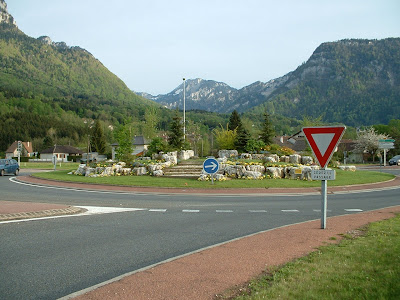
Other things to watch out for include sleeping policemen – called dos d’ânes – which are to be driven over as if there were thirteen double-decker buses to clear on the other side, STOP signs which are to be ignored and signs for speed limit which indicate the minimum speed at which you should drive. At least, I think that’s right.
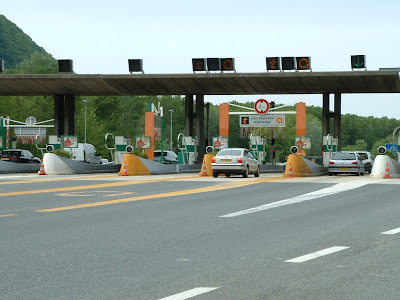
French motorways are beautifully maintained and - unlike in Britain, where service stations are so far apart it’s worth installing a Porta potty in the back seat – they have wonderful picnic areas called aires every few miles. Here you can meander through forest glades, stroll around a lake, visit a museum or even jog around an exercise circuit and in the south, you can cool down by walking through a sprinkler contraption similar to a car wash. Bien entendu, all this has a price – French motorways are not free and every now and again you will come upon a toll. You can either pay by credit card or by throwing the exact amount of coins required into a container, placed just far enough away from your car to ensure that you miss (people in right-hand drive cars shouldn’t even bother trying). If you are brave, you get out of the car and painstakingly pick all the coins from off the floor, under cars etc., despite the horn-blowing and death threats. If you’re not, you just scrabble desperately for more change and try again. This latter method may make you look like some frantic, undiscriminating benefactor but it’s probably safer.
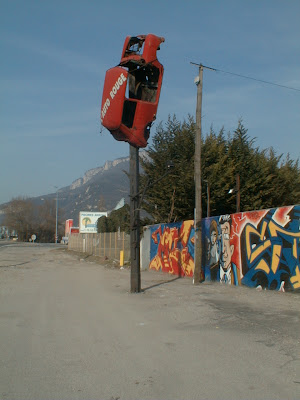
At least in France you can park (and I use the term loosely) wherever you like, the only restrictions being physical impossibility and even then, it’s not for want of trying. The pavement seems to be the most favoured place, but slap bang in the middle of the road is quite popular too. I once saw a car parked in the centre of a roundabout, but I think that may have been Art. Otherwise, you have to pay to park, although many people just screw up their parking fines and wait for the amnesty usually granted after every Presidential election. So, not long to wait then…
Watching the French drive is traumatic in itself so joining in could be seen as foolhardy. Fortunately, I have not had to pass the French driving test as I already earned my driving licence thirty years ago, tootling around my home town of Whitchurch in a short-sighted daze. Back then, a traffic jam was anything more than three Ford Cortinas and a combine harvester all trying to get out of the same car park: in those days you could do an Emergency Stop on the dual carriageway in the rush-hour and no-one would notice. Nonetheless, I still managed to write off my dad’s car a few months later on an isolated country road and it was with fear, trepidation and a new pair of glasses that I took up driving again a few years ago.
France is not the ideal country in which to do this, actually. Not only do they drive on the wrong side of the road – their steering wheels are also on the wrong side of the car. This can take some getting used to. At the beginning – provided you’ve remembered which door to open and are not sitting in the passenger seat with a bewildered look on your face – you may find yourself trying to wind down the window every time you want to change gear and vice versa. Believe me, this is the least of your worries.
It is all the fault of Napoleon, of course. He was a whimsical so-and-so at the best of times – I mean, he was a supporter of the French Revolution, thoroughly approved the lopping off of aristocrats’ heads and then promptly crowned himself Emperor of France and got jobs for all of his family. Anyway - research has shown that the Romans drove on the left and yet today, everyone in continental Europe drives on the right. One theory is that Napoleon had his troops march on the right-hand side because their muskets or pikes - which were slung over their right shoulders - would crash into each other as they passed in the narrow roads and create an awful lot of noise and bother which made everybody late for the invasions, wars etc. Personally, I think Napoleon was just being very French and flouting the rules for the heck of it.

While Road Rage is a comparatively recent phenomenon in Britain, in France it has always been an integral part of learning to drive. Some of the compulsory hand signals might not appear in the Le Code de la Route but they would certainly be immediately recognisable to anyone, regardless of nationality, trying to do a U-turn on a Friday afternoon on a busy main road. The same hand signals may be employed in similarly dangerous situations: stopping at a red traffic light, for example, or slowing down to let a pedestrian cross the road. Zebra crossings are lethal, in fact, because they lull the hapless walker into a false sense of security. As any seasoned driver knows, the idea is to slow down as you approach the crossing, thus allowing the pedestrian to scuttle half-way across, and then you must accelerate, forcing him to leap comically backwards into the old dear with the three shopping bags. Alternatively, he may just stand stock still like a petrified rabbit, in which case you have to screech to a halt, which can be quite impressive if you do it loudly enough.
Other things to watch out for include sleeping policemen – called dos d’ânes – which are to be driven over as if there were thirteen double-decker buses to clear on the other side, STOP signs which are to be ignored and signs for speed limit which indicate the minimum speed at which you should drive. At least, I think that’s right.

French motorways are beautifully maintained and - unlike in Britain, where service stations are so far apart it’s worth installing a Porta potty in the back seat – they have wonderful picnic areas called aires every few miles. Here you can meander through forest glades, stroll around a lake, visit a museum or even jog around an exercise circuit and in the south, you can cool down by walking through a sprinkler contraption similar to a car wash. Bien entendu, all this has a price – French motorways are not free and every now and again you will come upon a toll. You can either pay by credit card or by throwing the exact amount of coins required into a container, placed just far enough away from your car to ensure that you miss (people in right-hand drive cars shouldn’t even bother trying). If you are brave, you get out of the car and painstakingly pick all the coins from off the floor, under cars etc., despite the horn-blowing and death threats. If you’re not, you just scrabble desperately for more change and try again. This latter method may make you look like some frantic, undiscriminating benefactor but it’s probably safer.

At least in France you can park (and I use the term loosely) wherever you like, the only restrictions being physical impossibility and even then, it’s not for want of trying. The pavement seems to be the most favoured place, but slap bang in the middle of the road is quite popular too. I once saw a car parked in the centre of a roundabout, but I think that may have been Art. Otherwise, you have to pay to park, although many people just screw up their parking fines and wait for the amnesty usually granted after every Presidential election. So, not long to wait then…


